
Why dealership brand campaigns soak up budget and how to measure what they're really adding. The best-looking campaign in your Google Ads account is probably the one doing the least new work. That is not a coincidence it is how the reporting game is played.
Every month you get a report, and one line item always shines: low cost per click, sky-high conversion rate, cost per lead conversion that makes the rest of the account look wasteful by comparison. It is almost always your brand campaign the one that shows up when someone types your dealership's name into Google. And it is quietly setting the tone for how your entire program gets judged. Here is the uncomfortable question that report never answers: how much of your budget is buying customers you already had?
Why brand campaigns always look great
When someone searches your dealership by name, they have already made a decision. They saw your lot on the way to work, a friend sent them your inventory link, they watched a walkaround video last night. By the time they type your name, you are not competing for their attention you already won it. So the click is cheap, the conversion rate is enormous, and the cost per lead conversion looks incredible. But you did not earn most of that demand inside the ad account. It is the digital equivalent of counting the customer who walks onto the lot asking for you by name as a marketing win. The handshake feels great. It just is not new business.
The padding effect
The problem is not that brand campaigns perform well. It is that their numbers get blended into everything else. Your account-wide cost per lead conversion is an average. Drop a pile of $9 brand conversions into that average and the whole program looks efficient even if the campaigns actually fighting for new shoppers are struggling. One blended number hides the split. It is a single figure doing the work of two very different stories, and the cheaper story is the one dragging the average down to something you feel good about. That is the padding effect. Cheap, easy conversions make expensive, hard-won ones disappear into the mean.
What brand spend is actually for
To be clear: brand spend is not the villain here. There are real reasons to bid on your own name. Competitors bid on it. The dealership across town would love for their ad to sit above your organic result when your own customer goes looking for you. Bidding on your name protects that top spot and keeps a conquest campaign from intercepting a buyer who was yours to begin with. That is legitimate defense, and in competitive markets it matters. Brand spend is not evil. Unexamined brand spend is. The issue is never that the line item exists, it is that nobody separates it out, so nobody can tell you how much of it is genuine defense and how much is just budget riding on demand you already created.
The number nobody shows you
There is one figure that reframes the entire report, and it rarely appears on a dealer's dashboard: the percentage of total budget going to brand and what the account looks like once brand is pulled out of the average.
In one anonymized account we looked at, 41% of the monthly budget about $9,240 was going to brand clicks. Not to reaching new shoppers. To showing up for people already typing the store's name.
Separate that out and the two stories finally stand apart:
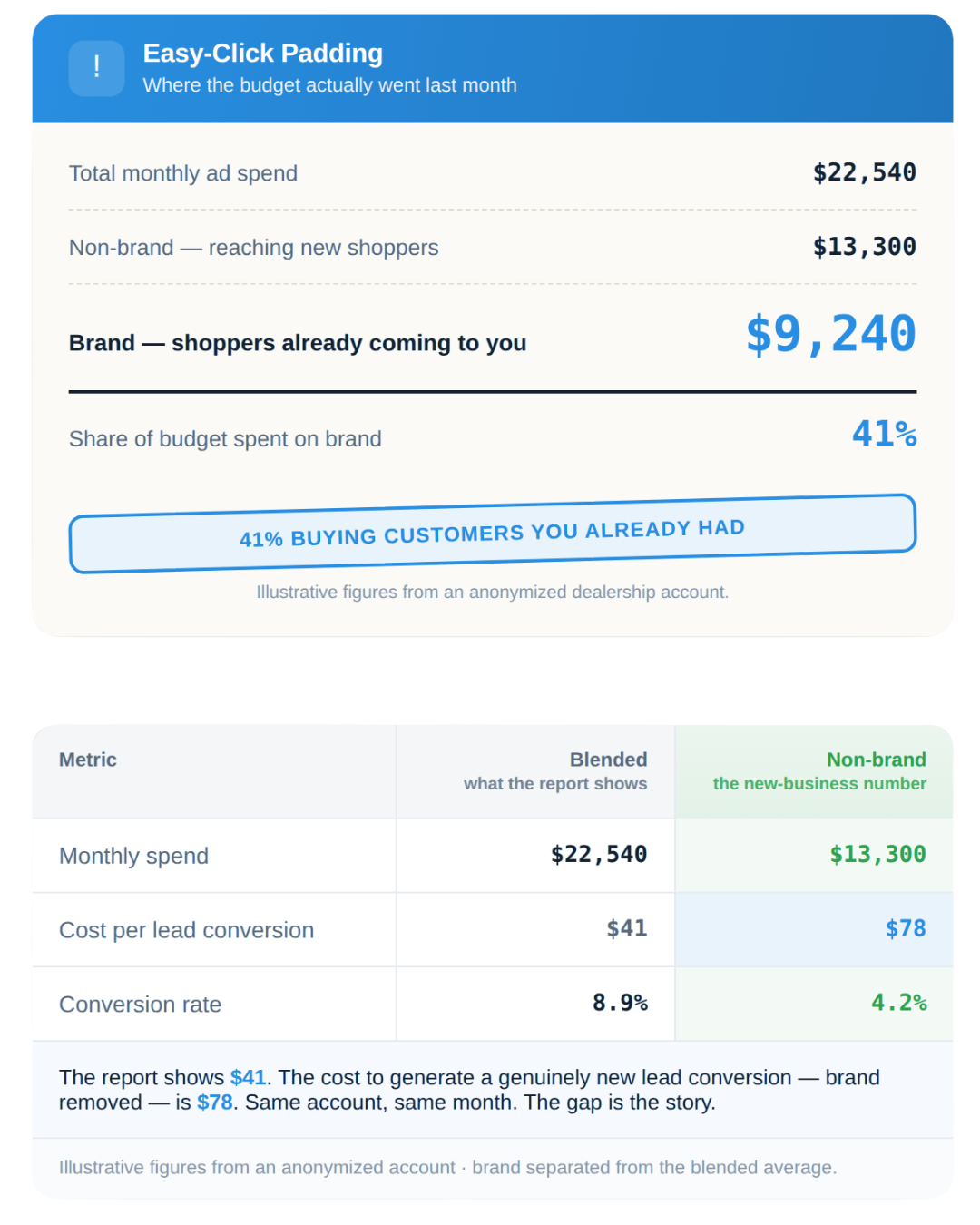
The blended cost per lead conversion the one on the monthly report was $41. The cost to actually generate a new lead conversion, with brand removed, was $78. Nearly double. Same account, same month. The gap between those two numbers is the part of the story the average was hiding.
The questions to ask your agency
You do not need to touch your budget to get clarity. You need answers. Bring these to whoever runs your account:
- What share of our total spend is brand versus non-brand?
- What is our non-brand cost per lead conversion, with brand pulled out of the average?
- Who is actually bidding on our name right now, and what does defending that top spot genuinely require?
These are questions, not instructions. The goal is to see the split you may have never been shown, so any decision you make afterward is made with both numbers in front of you instead of one.
DIY: check it yourself in 15 minutes
You can get close to this on your own before you ever talk to anyone:
- In Google Ads, filter your campaigns and search terms for anything containing your dealership's name.
- Total that spend. That is your brand spend divide it by total account spend to get your brand share.
- Now compute your conversion numbers with those brand campaigns and terms removed.
- Compare the blended cost per lead conversion to the non-brand cost per lead conversion.
The gap between those two numbers is the story. If it is small, your program is doing real new-business work. If it is wide, a chunk of your "performance" is demand you already owned.
How we check this in the free audit
When we run a free audit, this is one of the first things we separate. We pull your brand share of spend, measure brand versus non-brand effectiveness side by side, and hand you the report you have never actually seen: your account with the padding removed and the real new-business numbers standing on their own. No budget orders. No "you're doing it wrong." Just the split, in your own data, so you can finally answer the question your monthly report never has. Can you say what percentage of your budget buys shoppers who were already coming to you? The free audit answers it with your real data no cost, no obligation.